Inicio  /  Insights  /  Vibe Coding: 53% del Código IA Tiene VulnerabilidadesVibe Coding: 53% of AI Code Has Vulnerabilities

Vibe Coding: 53% del Código IA Tiene Vulnerabilidades Vibe Coding: 53% of AI Code Has Vulnerabilities

Vibe Coding: 53% del Código IA Tiene Vulnerabilidades

Vibe Coding, Brechas Reales

Programar por vibra es rápido y adictivo. El 53% de los equipos ya encontró vulnerabilidades en producción.

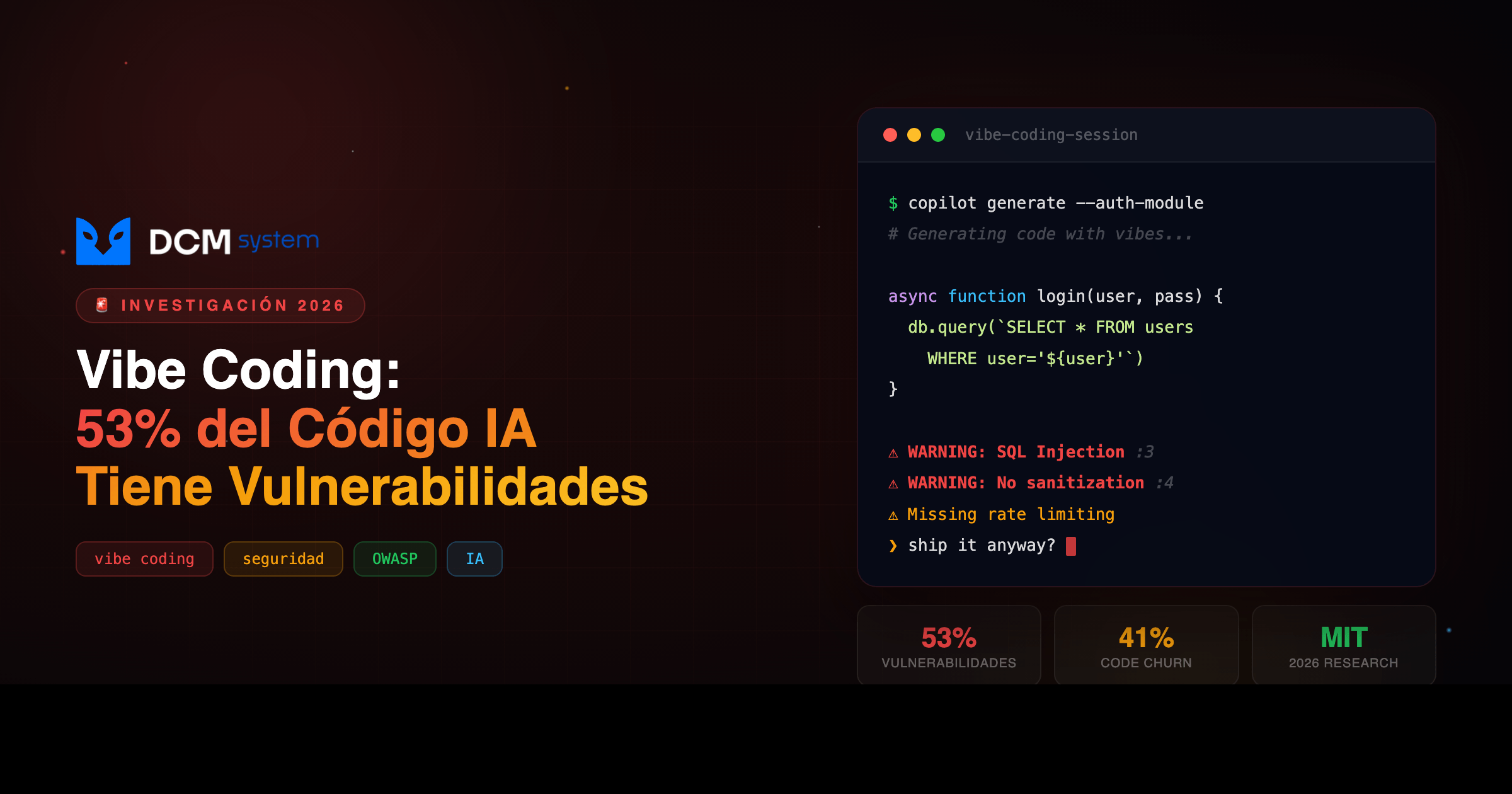
[DATO REAL]: Según Checkmarx y Palo Alto Networks, el 53% de los equipos que generan y despliegan código con IA ya encontraron vulnerabilidades de seguridad — después del deploy, con usuarios reales adentro.

En este artículo vas a:

  • Ver los 4 patrones de vulnerabilidad más comunes que genera el vibe coding (con código real)
  • Entender por qué el modelo nunca va a conocer tu arquitectura de seguridad
  • Aplicar el framework de 5 capas de DCM para vibear rápido sin abrir brechas
  • Saber qué puedes implementar hoy sin esperar a nadie

01 EL PROBLEMA REAL

Abres tu editor, le escribes al modelo “hazme un endpoint de login con JWT”, y en 30 segundos tienes algo que compila, responde y hasta se ve bonito. No tocaste una sola línea. Eso es vibe coding: programar por vibra, por intención, sin ensuciarte las manos con sintaxis.

La velocidad es real. La barrera de entrada desapareció. Startups lanzan MVPs en días. Desarrolladores senior saltean el boilerplate. Pero ese código que se siente mágico tiene un lado oscuro que casi nadie está viendo.

MIT Technology Review lo nombró una de las tecnologías revolucionarias de 2026. Fortune lo resumió: “In the Age of Vibe Coding, Trust Is the Real Bottleneck.” La velocidad ya no es el cuello de botella. La confianza en el output lo es.

PIÉNSALO ASÍ

Es como un piloto que deja de saber volar manual porque siempre usa autopiloto. Funciona — hasta que no funciona. Y cuando no funciona, estás a 10,000 metros de altura sin saber qué palanca tocar.

Antes El costo oculto Después
Dev escribe y entiende cada línea Velocidad × falta de criterio Código rápido con brechas que nadie detectó

02 POR QUÉ PASA

Un modelo de lenguaje genera código prediciendo el siguiente token más probable basado en patrones estadísticos de su entrenamiento. No tiene un modelo mental de tu sistema.

El modelo optimiza para que funcione, no para que sea seguro. Cuando le dices “hazme un endpoint de login”, te da el endpoint más probable según millones de ejemplos — muchos de ellos tutoriales, proyectos de aprendizaje, prototipos, demos. Código que nunca fue diseñado para producción.

Lo que el modelo no tiene:

  • Contexto de amenazas: no sabe qué vectores de ataque aplican a tu stack específico
  • Conocimiento de compliance: no sabe si necesitas SOC 2, GDPR, o la normativa colombiana de habeas data
  • Visión de arquitectura: no sabe cómo tu componente se integra con el resto del sistema
  • Historial de incidentes: no conoce las vulnerabilidades que ya te han explotado antes

Investigadores de Stanford confirmaron el efecto en 2023: los desarrolladores que usaban asistentes de IA producían código significativamente menos seguro — y estaban más convencidos de que su código era seguro. Más confianza, más riesgo.

GitClear lo midió: proyectos con herramientas de IA tienen un 41% más de code churn — código que se escribe y se reescribe rápidamente. Más superficie de ataque, más líneas que nadie revisó con atención.


03 LA SOLUCIÓN

Estos son los 4 patrones de vulnerabilidad que el vibe coding produce de forma consistente:

1. Inyección SQL — el clásico que sigue vivo

# Lo que el modelo genera (VULNERABLE)
@app.route('/api/users')
def search_users():
    name = request.args.get('name')
    query = f"SELECT * FROM users WHERE name = '{name}'"
    result = db.execute(query)
    return jsonify([dict(row) for row in result])
# Atacante mete: ' OR '1'='1' -- → devuelve toda la tabla
# SEGURO — un parámetro, toda la diferencia
@app.route('/api/users')
def search_users():
    name = request.args.get('name')
    query = "SELECT * FROM users WHERE name = %s"
    result = db.execute(query, (name,))
    return jsonify([dict(row) for row in result])

2. Secrets en texto plano

# VULNERABLE — el modelo hardcodea credenciales porque así las vio en training
client = boto3.client('s3',
    aws_access_key_id='AKIAIOSFODNN7EXAMPLE',
    aws_secret_access_key='wJalrXUtnFEMI/K7MDENG/bPxRfiCYEXAMPLEKEY')

GitHub detecta más de 1 millón de secretos expuestos por año en repositorios públicos. Con vibe coding, ese número solo crece.

3. Validación que no valida nada (Mass Assignment)

// "Hazme un formulario de registro con validación" — resultado:
app.post('/api/register', (req, res) => {
  const { email, password, role } = req.body;
  if (!email.includes('@')) return res.status(400).json({ error: 'Email inválido' });
  // El modelo "validó" el email. Y aceptó cualquier rol que mande el usuario.
  db.query('INSERT INTO users VALUES (?, ?, ?)', [email, password, role]); // role = "admin" 🤷
});

El modelo no entiende tu modelo de permisos. No sabe qué roles existen. Te dio exactamente lo que pediste — y nada más.

4. Deserialización insegura — la más sutil

# VULNERABLE — ejecución remota de código disfrazada de feature
@app.route('/api/session', methods=['POST'])
def restore_session():
    data = request.json.get('session_data')
    session = pickle.loads(base64.b64decode(data))  # ← RCE directo
    return jsonify(session)

pickle.loads con datos del usuario es ejecución remota de código. Un atacante serializa un payload que ejecuta comandos arbitrarios en tu servidor.


04 CÓMO IMPLEMENTARLO

El framework de 5 capas de DCM para vibear rápido sin abrir brechas:

  1. Prompts defensivos — no le pidas “hazme un endpoint”, dale contexto de seguridad explícito:

    Genera un endpoint REST para buscar usuarios por nombre.
    Requisitos: consultas parametrizadas, validación de input,
    rate limiting, sin IDs internos en respuesta, errores sin
    detalles del sistema, logs de intentos fallidos para auditoría.
    
  2. Revisión automatizada pre-commit — SAST (Semgrep, CodeQL, SonarQube) + detección de secrets (TruffleHog, Gitleaks) como pre-commit hooks. Si hay un SQL concatenado o un secret hardcodeado, el código no pasa. No depende de que alguien lo note.

  3. Code review con foco en seguridad — la automatización no puede ver la lógica de negocio, los flujos de autorización ni cómo se integra el componente. Cada PR pasa por un ingeniero revisando: autenticación/autorización, manejo de datos sensibles, puntos de entrada/salida, consistencia con la arquitectura global.

  4. Testing de seguridad continuo en CI/CD — tests de inyección (verificar que cada input está parametrizado), tests de autorización (confirmar que cada endpoint respeta roles), tests de límites (payloads malformados, enormes, vacíos), DAST (probar la app en ejecución como un atacante). No son opcionales, no se saltan “porque es urgente”.

  5. Monitoreo post-deploy — el deploy no es el final. Monitoreo de comportamientos anómalos en endpoints, alertas por tráfico sospechoso, revisión periódica de dependencias por CVEs, plan de respuesta a incidentes documentado y practicado.


05 ¿ES PARA TI?

Sí, si tu empresa:

  • ✅ Usa vibe coding para deployar a producción sin una capa de revisión entre el output y el servidor
  • ✅ No tiene pre-commit hooks de seguridad ni SAST en el pipeline
  • ✅ Tiene MVPs lanzados rápido que ahora manejan datos de usuarios reales

No, si:

  • ❌ Ya tienes SAST, detección de secrets y revisión humana con foco en seguridad en cada PR
  • ❌ Tu código es solo para uso interno sin datos sensibles ni acceso a infraestructura crítica

Preguntas frecuentes

¿El modelo va a mejorar y dejar de generar vulnerabilidades? Parcialmente. Mejora en errores obvios. Pero el problema raíz — falta de contexto de tu arquitectura, tu modelo de amenazas y tu compliance — no se resuelve con más parámetros. Se resuelve con proceso.

¿Cuánto tarda implementar los pre-commit hooks? Un día. Configurar Semgrep + TruffleHog + pre-commit hooks toma entre 4-8 horas. Te salva meses de remediation después de un breach.

¿Trato el código de IA como código de producción o como prototipo? Trátalo como código de un junior talentoso: rápido, creativo, pero sin experiencia en producción. Necesita supervisión, guía y validación antes de llegar a usuarios reales.


Acción inmediata: Corre semgrep --config=p/security-audit src/ en tu repo hoy. Si tienes código generado por IA que llegó a producción sin auditarse, eso te muestra dónde están los agujeros. Menos de 30 minutos.

¿Quieres ayuda? → Habla con DCM — vibeamos rápido, pero desplegamos seguro.

Vibe Coding: Why 53% of AI-Generated Code Has Vulnerabilities (and How to Protect Yourself)

You open your editor, type “build me a login endpoint with JWT,” and in 30 seconds you’ve got something that compiles, responds, and even looks good. You didn’t touch a single line. You just described what you wanted and the machine gave it to you. That’s vibe coding: programming by intent, by feel, without getting your hands dirty with syntax.

MIT Technology Review named it one of the breakthrough technologies of 2026. And it makes sense: the speed’s insane, the barrier to entry has vanished, and suddenly everyone can “code.” Startups use it to ship MVPs in days. Product teams use it to prototype without waiting for the backlog. Senior devs use it to skip boilerplate.

But here’s the problem. That code that feels magical has a dark side that almost nobody’s paying attention to. And the numbers are brutal.


The Vibe Brings Uninvited Friends

Let’s get concrete. This is what a typical model generates when you ask it for “an endpoint to search users by name”:

# "Build me an endpoint to search users"
@app.route('/api/users')
def search_users():
    name = request.args.get('name')
    query = f"SELECT * FROM users WHERE name = '{name}'"
    result = db.execute(query)
    return jsonify([dict(row) for row in result])

Looks clean, right? It works. It even passes basic tests. But any attacker with half a brain sends this in the name parameter:

' OR '1'='1' --

And suddenly your endpoint returns the entire users table. Congratulations: you’ve got a textbook SQL injection generated by your favorite AI assistant. This isn’t a hypothetical scenario. Stanford researchers demonstrated in 2023 that developers using AI assistants produced significantly less secure code and, worse, were more confident that their code was secure.

The safe version isn’t even more complicated:

@app.route('/api/users')
def search_users():
    name = request.args.get('name')
    query = "SELECT * FROM users WHERE name = %s"
    result = db.execute(query, (name,))
    return jsonify([dict(row) for row in result])

One parameter. That’s all that separates your database from disaster. But the model didn’t do it because nobody explicitly asked for it. And that’s the fundamental problem with vibe coding: the model optimizes for working, not for being secure.

Secrets in Plain Text

Another classic. You ask the model to set up an AWS connection and it gives you this:

import boto3

client = boto3.client(
    's3',
    aws_access_key_id='AKIAIOSFODNN7EXAMPLE',
    aws_secret_access_key='wJalrXUtnFEMI/K7MDENG/bPxRfiCYEXAMPLEKEY',
    region_name='us-east-1'
)

Hardcoded credentials right in the source code. If that reaches a repository – and it happens way more than you’d think – anyone with repo access has the keys to your infrastructure. GitHub reports detecting over 1 million exposed secrets per year in public repositories. With vibe coding, that number’s only going to grow.

Validation That Validates Nothing

// "Build me a registration form with validation"
app.post('/api/register', (req, res) => {
  const { email, password, role } = req.body;
  
  // The model "validated" the email... and nothing else
  if (!email.includes('@')) {
    return res.status(400).json({ error: 'Invalid email' });
  }
  
  // Accepts whatever role the user sends. Any role.
  db.query(
    'INSERT INTO users (email, password, role) VALUES (?, ?, ?)',
    [email, password, role]  // role = "admin"... why not?
  );
  
  res.json({ success: true });
});

The user sends "role": "admin" in the body and your system accepts it without question. Mass assignment, straight out of the textbook. The model didn’t think to validate which roles are allowed because you said “build me a registration” and it built you exactly that. It doesn’t understand your permission model. It doesn’t know what roles exist. It has no idea about your security architecture.

Insecure Deserialization

This one’s the scariest because it’s more subtle:

import pickle
import base64

@app.route('/api/session', methods=['POST'])
def restore_session():
    data = request.json.get('session_data')
    session = pickle.loads(base64.b64decode(data))
    return jsonify(session)

pickle.loads with user data. This is remote code execution. An attacker can serialize a payload that executes arbitrary commands on your server. It’s like giving your house keys to a stranger and wondering why you got robbed.


The Numbers Don’t Lie

Let’s get into the hard data, because anecdotes convince but numbers close the argument.

According to research from Checkmarx and Palo Alto Networks, 53% of teams generating and deploying AI code have already found security vulnerabilities after deployment. Not before. After. When the code was already in production serving real users.

GitClear analyzed millions of lines of code and found that projects using AI tools have 41% more “code churn” – code that gets written and rewritten rapidly. That means more code, but not better code. More attack surface, more lines nobody reviewed carefully, more opportunities for something to slip through.

Harvard Business School published research that puts the problem in perspective: researchers found that when developers rely too heavily on automatic generation, their ability to detect subtle bugs degrades. It’s like a pilot who forgets how to fly manual because they always use autopilot. Works great until it doesn’t.

And Fortune summed it up perfectly in a recent piece: “In the Age of Vibe Coding, Trust Is the Real Bottleneck.” Speed’s no longer the bottleneck. Trust is. Trust that the code does what it says, that it doesn’t have backdoors, that someone with judgment reviewed it before deployment.

As we analyzed in detail in our article on who reviews AI code security, the problem isn’t the tool. The problem’s the total absence of process between “the model generated it” and “it’s in production.”


Why AI Doesn’t Understand Your Architecture

This is where most people get lost. They think the model makes mistakes because of “technical limitations” that’ll get fixed in the next release. But the problem’s deeper than that.

A language model generates code by predicting the most probable next token based on statistical patterns from its training data. It doesn’t have a mental model of your system. It doesn’t know your API’s exposed to the internet. It doesn’t know your database contains patient information regulated by data protection laws. It doesn’t know your microservice communicates with three other services that have their own authentication rules.

When you say “build me a login endpoint,” the model gives you the most probable login endpoint based on millions of training examples. Many of those examples were tutorials, learning projects, prototypes, demos. Code that was never designed for production.

The model lacks:

  • Threat context: it doesn’t know which attack vectors apply to your specific stack
  • Compliance knowledge: it doesn’t know if you need SOC 2, GDPR, or regional data protection regulations
  • Architecture vision: it doesn’t know how your component integrates with the rest of the system
  • Incident history: it doesn’t know about vulnerabilities that’ve already been exploited against you

That’s why, as we explain in why we work with real engineers, AI’s an extraordinary tool in the hands of someone who knows what they’re doing. And a machine for generating technical debt and security holes in the hands of someone who doesn’t.


The DCM 5-Layer Framework for Secure AI-Assisted Development

At DCM System we’ve been building software for companies for over 12 years. We’ve adopted AI tools because speed matters. But we’ve developed an internal framework that ensures that speed doesn’t translate into vulnerabilities. We call it the 5 Layers and it’s what we apply to every project:

Layer 1: Defensive Prompts

You don’t ask the model to “build me an endpoint.” You give it security context:

Generate a REST endpoint to search users by name.
Security requirements:
- Use parameterized queries (never concatenate SQL)
- Validate and sanitize all user input
- Implement rate limiting
- Don't expose internal IDs in the response
- Handle errors without revealing system details
- Log failed attempts for auditing

Output quality depends directly on input quality. Defensive prompts aren’t optional; they’re the first line of defense.

Layer 2: Automated Pre-Commit Review

Before any code reaches the repository, it passes through automated scanners:

  • SAST (Static Application Security Testing): tools like Semgrep, CodeQL, or SonarQube that detect known vulnerability patterns
  • Secret detection: tools like TruffleHog or GitLeaks that scan for exposed credentials, tokens, and keys
  • Security linting: framework-specific rules that prevent dangerous patterns

This is configured as pre-commit hooks. If the code has a concatenated SQL query or a hardcoded secret, it doesn’t pass. It doesn’t depend on someone noticing it during code review.

Layer 3: Code Review with Security Context

Human code reviews are irreplaceable, but they need to focus on what automation can’t see: business logic, authorization flows, and how the component integrates with the rest of the system. Every pull request at DCM goes through at least one engineer who specifically reviews:

  • Authentication and authorization flows
  • Sensitive data handling
  • Data entry and exit points
  • Consistency with overall architecture

Layer 4: Continuous Security Testing

Testing functionality isn’t enough. You need to test resilience:

  • Injection tests: verify every input’s parameterized
  • Authorization tests: confirm every endpoint respects role boundaries
  • Boundary tests: send malformed, oversized, and empty payloads
  • DAST (Dynamic Application Security Testing): test the running application like an attacker would

These tests run in every CI/CD pipeline. They’re not optional, they don’t get skipped “because it’s urgent.”

Layer 5: Post-Deploy Monitoring and Response

Deployment isn’t the end. It’s the beginning of the vigilance phase:

  • Anomalous behavior monitoring on endpoints
  • Alerts for suspicious traffic patterns
  • Periodic dependency review for known CVEs
  • Incident response plan documented and practiced

What We Do Differently (and What You Can Do Today)

Look, we’re not anti-AI. At DCM we use tools like Claude Code to accelerate development – in fact, we’ve got a full guide on how to use it. But the difference between using it well and using it badly is enormous.

Here’s what you can implement today, without waiting for anyone:

1. Never deploy code that only the machine reviewed. There always needs to be a human with system context reviewing the output. You don’t need to review every line of CSS. You need to review every point where information enters or exits.

2. Invest in your security pipeline before investing in speed. Setting up Semgrep + TruffleHog + pre-commit hooks takes a day. It’ll save you months of remediation after a breach.

3. Treat AI-generated code like code from a talented junior. It’s fast, it’s creative, but it’s got no production experience. It needs supervision, guidance, and validation.

4. Document your architecture so your prompts have context. If the model doesn’t know your API’s public, it won’t generate rate limiting. If it doesn’t know you handle health data, it won’t think about compliance. Give it real context and the output improves dramatically.

5. Measure churn, not just speed. If your team’s generating more lines but rewriting 40% of them the next month, you’re not gaining velocity. You’re accumulating compound-interest debt.


The Vibe Is Real, But So Is the Risk

Vibe coding isn’t going away. It’s too useful, too fast, too accessible. And that’s fine. Technology advances and adapting isn’t optional.

But if your security strategy for AI-generated code is “we trust the model” or “we’ll review it later,” you’re playing Russian roulette with your infrastructure, your data, and your customers’ trust.

53% of teams have already found vulnerabilities. Don’t be part of the statistic. Be the team that vibes fast but deploys secure.

At DCM System we build software with the most advanced tools on the market, but with the security processes that only 12 years of real experience can give you. If you want to know how your team can adopt AI without opening the door to vulnerabilities, check out our services or talk to us directly.

The vibe’s good. But security’s non-negotiable.

Tu proyecto merece ingenieros reales

Your project deserves real engineers

12+ años construyendo software seguro. Hablemos sobre lo que necesitas.

12+ years building secure software. Let's talk about what you need.

Iniciar Conversación Start Conversation