Inicio  /  Insights  /  LATAM Recibe el Doble de Ciberataques que EE.UU.LATAM Gets 2x More Cyberattacks Than the US

LATAM Recibe el Doble de Ciberataques que EE.UU. LATAM Gets 2x More Cyberattacks Than the US

LATAM Recibe el Doble de Ciberataques que EE.UU.

LATAM Bajo Ataque

Las empresas colombianas reciben el doble de ciberataques que las de EE.UU. — con un tercio de la inversión en defensa.

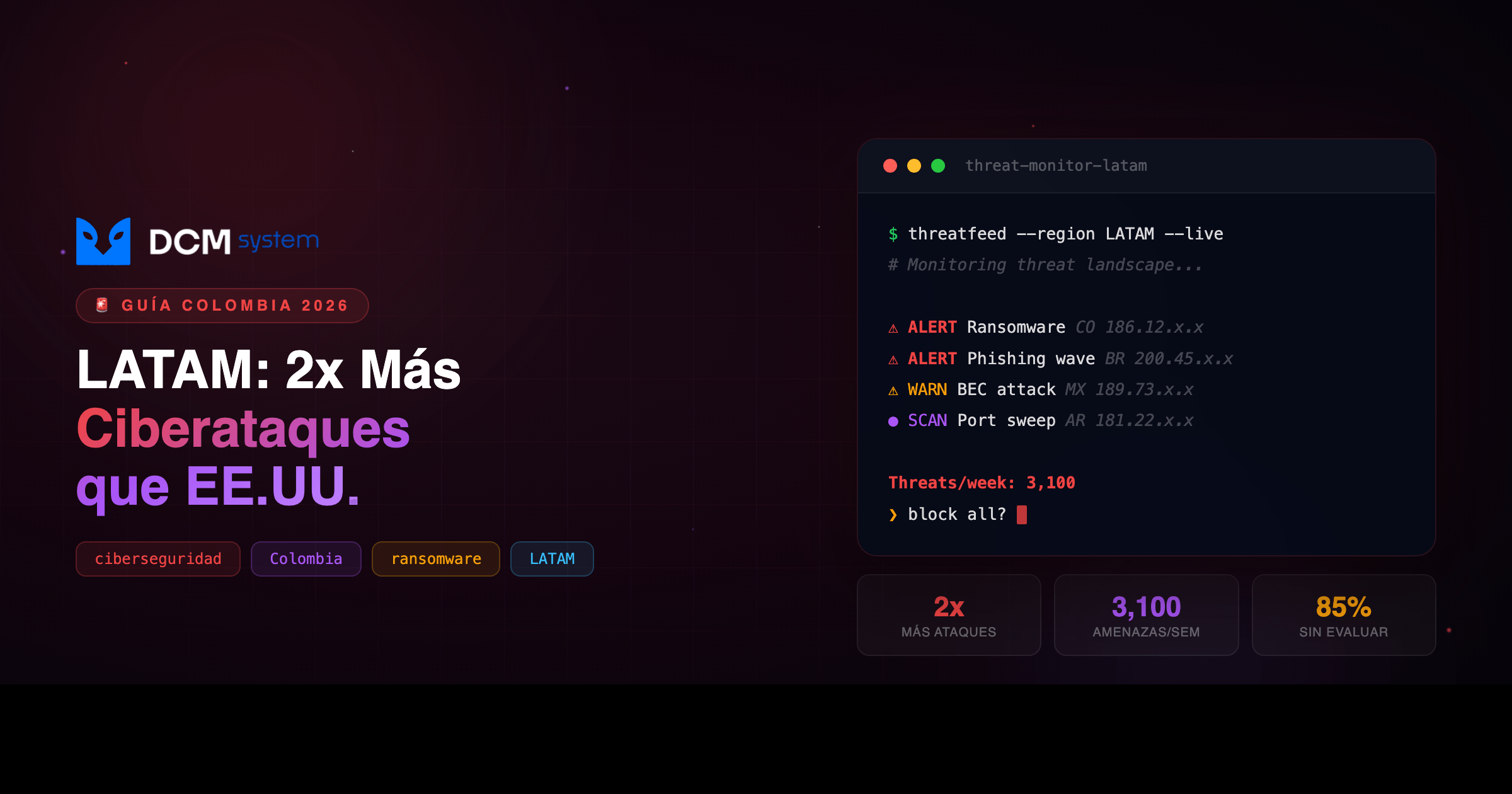
[DATO REAL]: América Latina recibe 3,100 amenazas activas por semana y representa el 12% de los incidentes globales de IBM X-Force con solo el 4% de la inversión mundial en ciberseguridad. Fuente: IBM X-Force Threat Intelligence Index + WEF Global Cybersecurity Outlook 2026.

En este artículo vas a:

  • Entender por qué Colombia es el 2.° o 3.° país más atacado de LATAM (con una economía mucho más pequeña que Brasil o México)
  • Conocer los 5 vectores de ataque activos ahora mismo en empresas colombianas
  • Saber exactamente qué te exige la ley colombiana — y qué le cuesta a tu empresa ignorarlo
  • Armar un plan de defensa según tu presupuesto real, sin charlatanería

01 EL PROBLEMA REAL

Colombia es un blanco desproporcionado. No por el tamaño de su economía, sino por el desbalance entre los datos que manejan sus empresas y la inversión que hacen para protegerlos.

El World Economic Forum Global Cybersecurity Outlook 2026 lo dice sin rodeos: la brecha entre capacidad defensiva y volumen de ataques en LATAM se está ampliando, no cerrando. Cada año estamos peor en términos relativos.

Y el 85% de las empresas de la región no evalúan la seguridad de las herramientas de IA antes de implementarlas. ChatGPT, Copilot, automatizaciones en la nube — todo corriendo sin política de seguridad. Riesgo sobre riesgo.

Lo que falta no es tecnología. Es decisión.

PIÉNSALO ASÍ

Es como un banco sin alarma en un barrio con alta criminalidad. Las empresas colombianas manejan los mismos datos sensibles que las gringas — financieros, médicos, legales — pero con una fracción de la inversión en protección.

Antes de actuar El costo Después de actuar
Blanco fácil, sin backups, sin plan Rescate de 50–500 MM COP Más difícil de atacar que el vecino

02 POR QUÉ PASA

Los atacantes operan con lógica de mercado. LATAM ofrece la combinación perfecta de datos valiosos con defensas débiles.

Transformación digital sin seguridad. La pandemia empujó a miles de empresas a digitalizarse en meses — e-commerce, pasarelas de pago, nube — y la seguridad quedó “para después”. Ese después nunca llegó.

Poca cultura de reporte. En EE.UU., un breach se reporta por obligación legal. Acá, la mayoría de incidentes se tapan o no se detectan. Los atacantes pueden vivir meses dentro de una red sin que nadie lo note.

Supply chain como puerta trasera. Las empresas grandes subcontratan a proveedores pequeños con cero seguridad. Comprometes al chico y tienes acceso al grande. Es el mismo vector de SolarWinds, pero mucho más fácil.

Ransomware como negocio escalable. Los grupos de ransomware descubrieron que las pymes latinoamericanas pagan. No tienen backups, no tienen plan, y un par de millones de pesos es nada comparado con una semana offline.


03 LA SOLUCIÓN

No hay un software mágico. Hay una decisión consciente de dejar de ser un blanco fácil.

Los atacantes siguen la ley del menor esfuerzo. Si tenés MFA, backups funcionales y un equipo que sabe identificar phishing, el atacante va a buscar al vecino que no tiene nada. No tenés que ser Fort Knox — tenés que ser más difícil que el de al lado.

Los 5 vectores activos en empresas colombianas ahora mismo:

1. Ransomware dirigido a pymes. Grupos como LockBit 3.0 y los sucesores de BlackCat tienen programas de afiliados. Cualquiera compra acceso a herramientas de ransomware y ataca pymes de 20–200 empleados. Entran por phishing o VPN desactualizada, se mueven lateralmente durante días, y cifran todo un viernes por la noche. El 60% paga porque no tiene backups funcionales.

2. Phishing con IA generativa. Ya no hay errores de ortografía ni príncipes nigerianos. Los correos son perfectos en español colombiano, imitando la DIAN, Bancolombia, la SIC. IBM X-Force reporta un aumento del 266% en uso de infostealers en LATAM distribuidos vía phishing.

3. Business Email Compromise (BEC). El favorito contra empresas con comercio exterior. El atacante compromete un correo en la cadena de comunicación y modifica datos de pago en una factura. La empresa paga al atacante. Casos documentados: USD 50,000 a USD 300,000 en una sola transacción.

4. Ataques a la cadena de suministro de software. Un atacante compromete una librería, un plugin, una API de proveedor pequeño — y entra a tu sistema. El vibe coding (apps generadas con IA sin revisar el código) está amplificando este vector brutalmente.

5. Credenciales y accesos expuestos. Contraseñas reutilizadas, RDP abierto a internet, bases de datos MongoDB sin autenticación, buckets S3 públicos con datos sensibles. Shodan muestra miles de servicios colombianos expuestos sin protección. La puerta abierta de par en par.


04 CÓMO IMPLEMENTARLO

El plan varía según presupuesto. No todas las empresas necesitan lo mismo — pero todas necesitan algo.

Nivel $ — Presupuesto mínimo (COP $2–5 MM/mes) — para pymes de 10–50 empleados:

  1. MFA en todo. Correo, VPN, paneles admin, cuentas bancarias. Google/Microsoft Authenticator son gratis. Bloquea el 99% de ataques por credenciales robadas.
  2. Backups 3-2-1 automatizados. Tres copias, dos medios, una offsite. Veeam Community Edition (gratis hasta 10 cargas) o Duplicati (open source). Testea la restauración cada mes — un backup no probado no es backup.
  3. Actualizaciones automáticas. Configura Windows Update, firmware de routers/firewalls, y parcha servidores en menos de 48h post-parche crítico. El 60% de los breaches explotan vulnerabilidades que ya tenían solución.
  4. Capacitación básica de phishing. Un taller trimestral de 2 horas. KnowBe4 tiene planes accesibles.
  5. Seguro de ciberriesgo. Desde COP $3 MM/año — Chubb, AIG, Sura tienen productos para el mercado colombiano.

Nivel $$ — Presupuesto intermedio (COP $10–25 MM/mes) — para 50–200 empleados o datos sensibles:

Todo lo anterior, más: firewall NGFW (FortiGate o Palo Alto), EDR (SentinelOne, CrowdStrike o Microsoft Defender for Business), pentesting semestral, monitoreo de logs con Wazuh o Elastic SIEM, y un plan de respuesta a incidentes documentado de 5–10 páginas.

Nivel $$$ — Presupuesto robusto (COP $50+ MM/mes) — para 200+ empleados o sectores regulados:

Todo lo anterior, más: SOC 24/7 (interno o MSSP), Zero Trust Architecture, programa de Bug Bounty o evaluación continua, DLP, y suscripción a inteligencia de amenazas (Recorded Future, Mandiant, o las alertas gratuitas del ColCERT).


05 ¿ES PARA TI?

Sí, si tu empresa:

  • ✅ Maneja datos de clientes, proveedores o empleados (todos los mandan la Ley 1581)
  • ✅ Tiene más de 10 personas con acceso a sistemas digitales
  • ✅ Hace transacciones bancarias o comercio exterior en línea

No, si:

  • ❌ Eres un freelancer sin empleados ni datos de terceros bajo tu responsabilidad
  • ❌ Tus operaciones son 100% offline y no usas ningún servicio en la nube

El terreno legal: lo que te exigen

Esto no es opcional. Colombia tiene marco legal específico y la SIC ya está investigando y sancionando.

Ley 1273 de 2009 — Delitos informáticos. Penas de 4 a 8 años y multas de hasta 1,000 SMLMV por acceso abusivo, interceptación de datos o uso de malware. Si tu empresa sufre un breach por negligencia comprobada, enfrentas responsabilidad civil y administrativa.

Ley 1581 de 2012 — Habeas Data. Obliga a implementar medidas de seguridad “apropiadas” para datos personales. Un breach puede resultar en multas de la SIC de hasta 2,000 SMLMV — más de 2,600 millones de pesos en 2026.

Decreto 338 de 2022. Si le vendés software o servicios al gobierno, este decreto te aplica directamente.

Circular 007 de 2018 de la SFC. Sector financiero: framework de ciberseguridad formal, evaluaciones periódicas y pruebas de penetración obligatorias.


Preguntas frecuentes

¿Cuánto cuesta un ataque de ransomware real para una pyme colombiana? Entre 50 y 500 millones de pesos en rescate — sin contar el tiempo offline, la pérdida de clientes y la exposición legal. El costo total suele ser 3–5x el rescate pagado.

¿El ColCERT me ayuda si sufro un ataque? Sí, pero son un equipo pequeño y su capacidad de respuesta individual es limitada. Lo ideal es tener tu propio plan antes de necesitarlos. Sus alertas gratuitas sí son valiosas para inteligencia preventiva.

¿Los seguros de ciberriesgo realmente pagan? Sí, pero leen la letra menuda. La mayoría requiere que tengas controles básicos implementados. Si no tienes MFA activo al momento del breach, pueden negarles la reclamación.


Acción inmediata: Abrí Shodan (shodan.io) y buscá el nombre de tu empresa o tu rango de IPs. Si aparecen servicios expuestos que no sabías que eran públicos, ya sabés por dónde empezar.

¿Quieres ayuda? → Hablá con DCM — llevamos 12 años construyendo software seguro en Colombia y no nos da miedo decirte la verdad sobre el estado de tu seguridad.

There’s a stat that should keep every IT manager in Bogota, Medellin, or Barranquilla up at night: companies in Latin America get hit with twice as many cyberattacks as companies in the United States. Not twice the attempts. Twice the successful attacks that breach defenses, steal data, and shut down operations.

And it’s not because they have better tech or smarter engineers up north. It’s because we’re an easier target. Way easier.

This isn’t paranoia. This is what Dark Reading, Recorded Future, the World Economic Forum, and IBM X-Force Threat Intelligence Index all report. Every data source points in the same direction: LATAM is in the crosshairs, Colombia is in the top 3 of the region, and most companies here don’t even have a basic incident response plan.

If you manage technology at a Colombian company — or worse, if you’re the owner and “the IT guy” is a single person who also handles tech support — this article is your wake-up call.

The numbers: this is how bad it is

Let’s go straight to the hard data. No sugarcoating.

3,100 threats per week. That’s the regional average according to cross-referenced data from IBM X-Force and Recorded Future for 2025-2026. These aren’t “potential risks.” They’re active detected threats: network scans, intrusion attempts, phishing campaigns, malware in distribution.

The World Economic Forum Global Cybersecurity Outlook 2026 dedicates an entire section to LATAM. The conclusion: the gap between the region’s defense capabilities and the volume of attacks it receives is widening, not closing. Every year we’re relatively worse off.

IBM X-Force reports that Latin America accounts for 12% of the global incidents their team handles, but only 4% of worldwide cybersecurity spending. We invest three times less per incident than any other region.

And here’s the part that really stings: according to ESET and Fortinet regional data, Colombia consistently ranks as the second or third most attacked country in LATAM, behind only Brazil and Mexico — countries with economies 5 to 10 times larger. Per capita, we’re taking a disproportionate beating.

85% of companies in the region don’t evaluate the security of AI tools before deploying them. The WEF reports this and we confirm it in the field: companies using ChatGPT, Copilot, and automation tools without any security policy. And as we’ve already analyzed, AI-generated code comes with its own vulnerabilities — so you’re stacking risks on top of risks.

Why LATAM is such a juicy target

Attackers aren’t stupid. They choose their targets with market logic, just like any business. And LATAM offers the perfect combination:

1. Weak defenses, valuable data. Colombian companies handle the same types of sensitive data as American ones — financial records, medical histories, personal information — but with a fraction of the investment in protection. It’s like a bank with no alarm in a high-crime neighborhood.

2. Rapid digital transformation without security. The pandemic pushed thousands of companies to digitize in months. They set up e-commerce, payment gateways, cloud systems… and security was left “for later.” Later never came.

3. Low reporting culture. In the US, a breach gets reported because there’s legal obligation and serious consequences. In Colombia, most incidents get covered up, minimized, or simply go undetected. Attackers know this — they can operate inside a network for months without anyone noticing or reporting anything.

4. Supply chain as a back door. Large companies in LATAM outsource to smaller vendors with zero security. Compromise the small vendor and you get access to the big company’s network. Same vector used in the SolarWinds attack, but here it’s far easier because most companies don’t have real engineers reviewing their infrastructure.

5. Ransomware as a business model. Ransomware groups discovered that Latin American SMBs pay up. They don’t have backups, no response plan, and a few million Colombian pesos is nothing compared to what they lose if they’re offline for a week. It’s systematized extortion at industrial scale.

The 5 attack vectors hitting Colombian businesses right now

This isn’t theory. These are the patterns we see in the field, confirmed by reports from ESET, Fortinet, IBM, and alerts from ColCERT (Colombia’s national incident response team).

1. Ransomware targeting SMBs

Forget the image of a hooded hacker going after multinationals. Groups like LockBit 3.0, the successors of BlackCat/ALPHV, and their variants run affiliate programs where anyone can buy access to ransomware tools and execute attacks. Their favorite targets in 2025-2026 are SMBs: companies with 20 to 200 employees that make enough revenue to pay a ransom but don’t have a dedicated security team.

In Colombia, we’ve seen logistics companies, clinics, law firms, and distributors paralyzed by ransomware. The pattern’s always the same: they get in through a phishing email or an outdated VPN, move laterally for days or weeks, exfiltrate data, and when everything’s ready, encrypt everything on a Friday night.

The typical ransom for a Colombian SMB: between 50 and 500 million COP. And 60% pay up because they don’t have functional backups.

2. AI-powered phishing

Phishing emails no longer have spelling errors or come from a “Nigerian prince.” With generative AI tools, attackers produce perfect emails in local Colombian Spanish, impersonating communications from DIAN (tax authority), Bancolombia, SIC (regulatory authority), or the Ministry of Labor. They even clone voices for “verification” calls — the infamous vishing.

IBM X-Force reports a 266% increase in infostealer usage (credential-stealing malware) in LATAM, many distributed via phishing. Stolen credentials sell on forums for pennies and serve as the initial vector for more complex attacks.

3. Business Email Compromise (BEC)

This is the favorite against Colombian companies engaged in international trade. The attacker compromises someone’s email in the communication chain — could be a Chinese supplier, a freight forwarder, or someone internal — and modifies the payment details on an invoice. The Colombian company pays the attacker’s account thinking they’re paying their vendor.

We’ve seen cases of USD 50,000 to USD 300,000 lost in a single transaction. And the company doesn’t find out until weeks later when the real vendor calls asking about their payment.

4. Software supply chain attacks

This is particularly relevant if your company uses custom software or depends on third-party integrations. An attacker compromises a library, a plugin, or a small vendor’s API, and through that dependency gains access to your system.

Vibe coding — generating entire applications with AI without reviewing the code — is amplifying this vector brutally. Companies deploying AI-built apps that import unaudited dependencies. It’s a ticking time bomb.

5. Exploitation of credentials and exposed access

Reused passwords, RDP services exposed to the internet, open MongoDB or Elasticsearch databases, public S3 buckets with sensitive data. Sounds basic, but this is how most successful attacks begin.

Shodan (the “Google of connected devices”) shows thousands of Colombian services exposed to the internet without authentication. Database servers, security cameras, industrial SCADA systems. It’s like leaving your front door wide open and being surprised when you get robbed.

The legal landscape: what Colombian law requires

This isn’t optional. Colombia has a specific legal framework for cybersecurity and data protection, and ignorance doesn’t exempt you from the consequences.

Law 1273 of 2009 — Computer crimes. Classifies as crimes unauthorized access to systems, data interception, malicious software use, and theft through computer means. Penalties of 4 to 8 years in prison and fines up to 1,000 minimum wages. Important: if your company suffers a breach due to proven negligence, you can face civil and administrative liability.

Law 1581 of 2012 — Habeas Data. Regulates the processing of personal data. Requires companies to implement “appropriate” security measures to protect the data they handle. If you suffer a breach, the Superintendencia de Industria y Comercio (SIC) can investigate and sanction you with fines up to 2,000 monthly minimum wages (that’s over 2.6 billion COP in 2026).

Decree 338 of 2022. Establishes digital security guidelines for public entities and their suppliers. If you sell software or services to the government, this applies directly to you.

Circular 007 of 2018 from SFC. If you’re in the financial sector, the Financial Superintendence requires a formal cybersecurity framework with periodic assessments, incident management, and penetration testing.

CONPES 3995 of 2020 — National Digital Trust and Security Policy. Defines the national strategy and creates obligations for critical sectors.

The key point: the SIC is already investigating and sanctioning. This isn’t dead legislation. In the past two years they’ve fined companies for inadequately protecting personal data. And the trend is toward tightening, not relaxing.

Survival guide: what to do based on your budget

Let’s get to the point. Not every company has the budget for a 24/7 SOC and that’s fine. Cybersecurity is a spectrum, not an on/off switch. What matters is moving from where you are now to somewhere less vulnerable.

Level $ — Minimum budget (COP $2-5 million/month, approx. USD $500-1,200)

For the 10-50 employee SMB that currently has nothing or next to nothing. These are the basics that can save you from most attacks:

Multi-factor authentication (MFA) on everything. Email, VPN, admin panels, bank accounts. No excuses in 2026. Google Authenticator is free. Microsoft Authenticator is free. This alone blocks 99% of stolen credential attacks.

Automated 3-2-1 backups. Three copies of your data, on two different media, with one copy offsite (outside your network). Use tools like Veeam Community Edition (free for fewer than 10 workloads) or Duplicati (open source). Test restoration every month. A backup that’s never been tested isn’t a backup.

Automatic updates. Configure Windows Update, automatic firmware updates on routers and firewalls, and a process to patch servers within 48 hours of a critical patch. 60% of breaches exploit vulnerabilities that already had available patches.

Basic phishing training. A quarterly 2-hour workshop. Teach your team to verify URLs, not to open suspicious attachments, and to report weird emails. Platforms like KnowBe4 have accessible plans for SMBs.

Cyber risk insurance. Starting at around COP $3 million per year (approx. USD $750), you can get a basic policy covering incident response and civil liability. Companies like Chubb, AIG, and Sura offer products for the Colombian market.

Level $$ — Intermediate budget (COP $10-25 million/month, approx. USD $2,500-6,000)

For 50-200 employee companies or SMBs handling sensitive data (healthcare, financial, legal):

Everything from the previous level, plus:

Next-generation firewall (NGFW). Fortinet FortiGate or Palo Alto PA-400 series. Not the ISP router with a “firewall” that came with your internet plan. A real firewall with IPS, SSL inspection, and application filtering.

EDR (Endpoint Detection and Response). SentinelOne, CrowdStrike, or at least Microsoft Defender for Business. Traditional antivirus is useless now. You need something that detects anomalous behavior, not just known signatures.

Biannual pentesting. Hire a penetration test every six months. It doesn’t have to be the most expensive firm — but it does have to be people who know what they’re doing. As we’ve said, there’s no substitute for real engineers.

Basic log monitoring. Centralize your logs in a tool like Wazuh (open source) or Elastic SIEM. Without visibility you can’t detect anything.

Documented incident response plan. A 5-10 page document that says: if X happens, we do Y. Who calls whom. Who has authority to disconnect systems. How external communication works. Practice it at least once a year.

Level $$$ — Robust budget (COP $50+ million/month, approx. USD $12,000+)

For 200+ employee companies, regulated sectors, or companies handling critical data:

Everything above, plus:

SOC as a service or internal SOC. 24/7 monitoring of your infrastructure. If you can’t build an internal team (you need at least 5-6 people for 24/7 coverage), hire an MSSP (Managed Security Service Provider).

Zero Trust Architecture. Trust nothing and no one by default. Network microsegmentation, continuous identity verification, least-privilege access. It’s a cultural and technical shift, but it’s where everything is headed.

Bug bounty program or continuous assessment. Platforms like HackerOne or Bugcrowd, or an agreement with a security firm for ongoing evaluation. AI can already find vulnerabilities automatically, but you need humans to validate and prioritize the findings.

DLP (Data Loss Prevention). Tools that detect and prevent unauthorized exit of sensitive data. Critical if you handle healthcare, financial, or legal data.

Threat intelligence. Subscription to intelligence feeds that tell you what’s being attacked in your sector and region. Recorded Future, Mandiant, or at least the free alerts from ColCERT and the National Police CSIRT.

What DCM builds differently

At DCM we’ve been building software for Colombian companies for over 12 years. In that time we’ve seen everything: from startups that deployed to production without a single security test to financial sector companies with security frameworks that existed only in PowerPoints nobody read.

What we’ve learned is this: security doesn’t get added at the end. It’s not another feature or a compliance checkbox. It’s a mindset that must be present from the first line of code to the last operational process.

That’s why when we build software, security is embedded in the process:

  • We review every line of code — whether written by humans or generated by AI. We’ve got formal code review processes with a security focus. Nothing goes to production without passing through human eyes that understand attack vectors.

  • We do threat modeling before writing the first line. Before we code, we map the threats. What data does the system handle, who might want access, what are the likely vectors, what happens if each component fails.

  • We integrate security testing into CI/CD. SAST, DAST, dependency analysis. Automated on every push. If you introduce a known vulnerability, the pipeline stops you before it reaches staging.

  • We understand the Colombian context. We know which laws apply, what the SIC demands, how ColCERT operates, which attacks are hitting the region. We don’t apply generic American playbooks — we adapt to local reality.

This doesn’t get fixed with a product, it gets fixed with a decision

Look, I’m not going to sell you the idea that there’s a magic software that’ll protect you from everything. That doesn’t exist. What does exist is the conscious decision to stop being an easy target.

Attackers follow the path of least resistance. If you’ve got MFA, functional backups, and a team that can spot a phishing attempt, the attacker will move on to your neighbor who has none of that. You don’t have to be Fort Knox — you just have to be harder to attack than the next guy.

The first step is honest: assess where you are today. No sugarcoating, no self-deception. How many of the Level $ measures do you have in place? If the answer is “few or none,” you already know where to start.

And if you need help — whether for a quick audit, to build software that isn’t a sieve of vulnerabilities, or to put together a security plan that fits your budget — let’s talk. We’ve been doing this for 12 years and we’re not afraid to tell you the truth about the state of your security.

Because the uncomfortable truth is always cheaper than the ransom invoice.

Tu proyecto merece ingenieros reales

Your project deserves real engineers

12+ años construyendo software seguro. Hablemos sobre lo que necesitas.

12+ years building secure software. Let's talk about what you need.

Iniciar Conversación Start Conversation