Digital Sin Qumar Plata
Transforma tu pyme colombiana por etapas — con presupuestos reales y sin buzzwords.
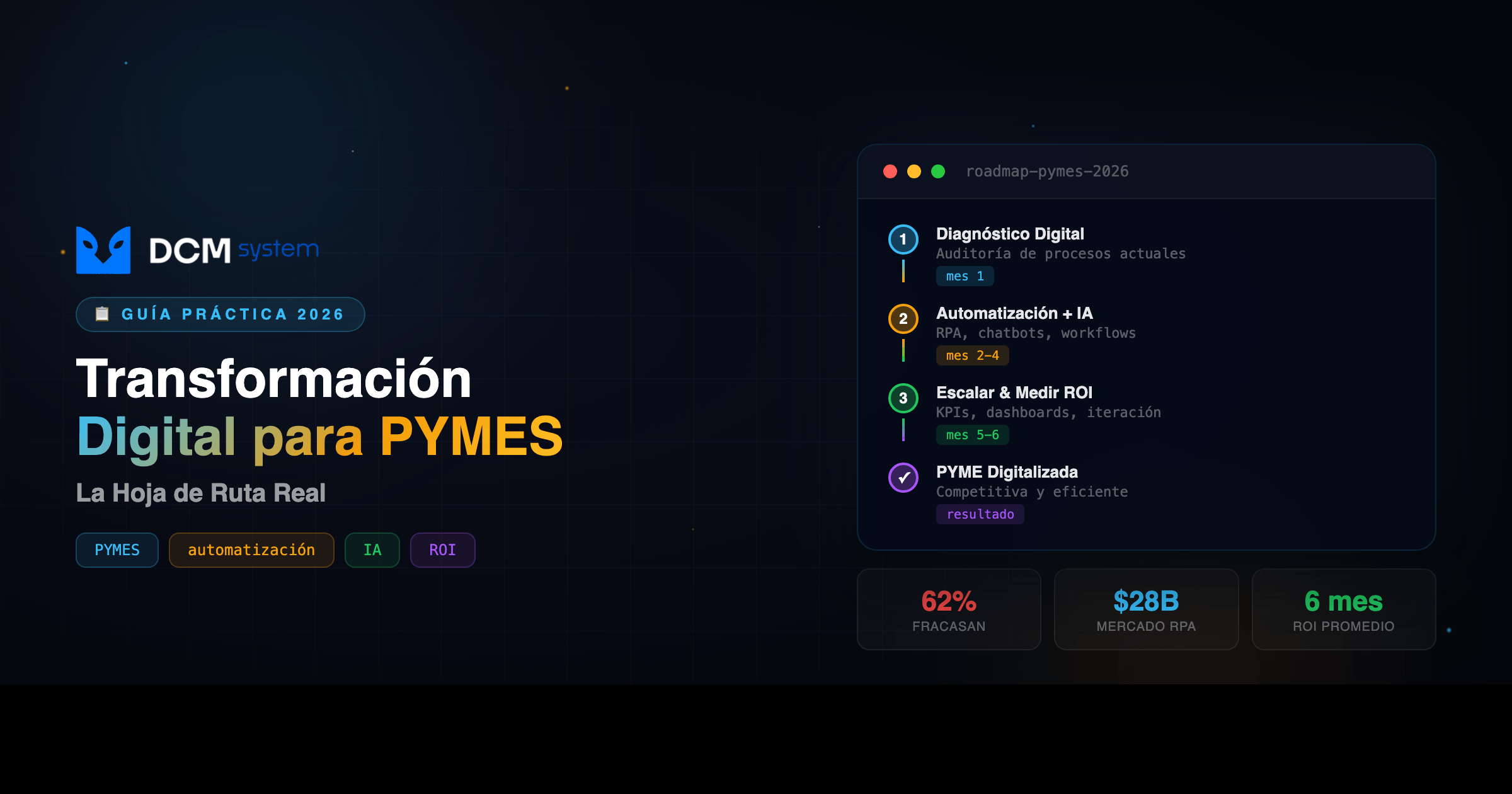
[DATO REAL]: El 62% de los proyectos de transformación digital fracasan. No startups experimentales — empresas reales que invirtieron plata real en software y consultores, y terminaron peor que antes. La causa principal no es tecnológica: compraron tecnología antes de entender sus propios procesos.
En este artículo vas a:
- Identificar en qué etapa de madurez digital está tu empresa hoy
- Seguir una hoja de ruta de 4 fases con tiempos reales, no teóricos
- Ver los rangos de costo reales en pesos colombianos para 2026
- Evitar los 5 errores que matan el 70% de los proyectos antes de terminar
01 EL PROBLEMA REAL
Llevamos 12 años en DCM construyendo software para empresas colombianas. Hemos visto este patrón cientos de veces: la empresa que gasta 200 millones en un ERP que nadie usa. La que monta un CRM y sigue manejando clientes en Excel porque nadie cambió el proceso. La que contrata una “transformación digital” que en realidad es un PowerPoint bonito que junta polvo en SharePoint.
El problema no es la tecnología. Es el orden. Primero compran la herramienta, después intentan acomodar sus procesos a ella. Es exactamente al revés.
PIÉNSALO ASÍ
Comprar tecnología antes de entender tus procesos es como comprar un Ferrari para una carretera destapada. El carro es increíble. Pero si no tienes la vía, no llegas a ninguna parte.
| Antes |
El costo |
Después |
| Procesos manuales y en silos |
Inversión sin diagnóstico |
Software costoso que nadie adopta |
| “Necesitamos Salesforce” |
Sin mapear el proceso de ventas |
70% de fracasos por resistencia al cambio |
| Todo a la vez, big bang |
Presupuesto quemado |
ERP de 18 meses que se vuelve de 36 |
02 POR QUÉ PASA
El 62% que fracasa se salta un paso: el diagnóstico honesto. No el que te vende el consultor para justificar su propuesta. El real.
Hay cuatro etapas de madurez digital, y no puedes saltar ninguna:
Etapa 1 — Manual: Facturas en Word, inventario en Excel, comunicación por WhatsApp, contabilidad que se cuadra a fin de mes con rezos. Sin datos centralizados. Si se va quien “sabe cómo funciona todo”, la operación se para. El 40% de las pymes colombianas están acá — no es vergüenza, es punto de partida.
Etapa 2 — Sistematizada: Ya tienes Siigo, Alegra, quizás un CRM básico. Pero cada herramienta vive en su mundo. Para sacar un informe de rentabilidad por cliente cruzas tres hojas de cálculo manualmente.
Etapa 3 — Integrada: Los sistemas hablan entre sí. CRM conectado con facturación, facturación con contabilidad. Dashboards en tiempo real. Decisiones basadas en datos.
Etapa 4 — Inteligente: Los sistemas aprenden. Automatizaciones que procesan tareas repetitivas sin intervención humana. Modelos predictivos que te dicen cuándo un cliente va a dejar de comprarte o dónde estás perdiendo margen. IA embebida en tus herramientas, no una plataforma aparte que nadie entiende.
Si estás en etapa 1 y quieres ir directo a la 4, vas a fracasar. Garantizado.
03 LA SOLUCIÓN
La transformación digital que funciona es la que avanza por fases, demuestra ROI rápido y escala lo que da resultados.
Fase 1 — Diagnóstico y mapeo (Semanas 1–4)
Antes de tocar tecnología, mapeas tus procesos críticos: los que generan plata y los que la queman. Típicamente son 5 a 10 procesos core — ventas, facturación, compras, inventario, cobranza, atención al cliente. Para cada uno: quién lo hace, cuánto se demora, dónde hay cuellos de botella, qué datos se generan, dónde se pierden cosas. Esto se puede hacer con post-its y una pared. El resultado: un mapa claro de dónde la tecnología tiene mayor impacto. Esto es exactamente lo que el 62% que fracasa se salta.
Fase 2 — Quick wins de automatización (Meses 2–3)
Identificas las ganancias rápidas: procesos manuales, repetitivos y de alto volumen. Los clásicos:
- Cuentas por pagar: automatizar aprobación de facturas. ROI en menos de 6 meses. Una pyme con 200+ facturas/mes recorta hasta un 70% del tiempo manual.
- Facturación electrónica: si todavía facturas manual, esto es prioridad uno. La DIAN ya lo exige, hay soluciones desde COP $50,000/mes.
- Chatbot de soporte: las 20 preguntas que representan el 80% de consultas. No necesitas GPT-4 — un árbol de decisión bien diseñado resuelve la mayoría.
Esto logra dos cosas: ahorra plata inmediatamente y genera momentum. Cuando el equipo ve que la automatización les quita el trabajo aburrido (no el empleo), se vuelven aliados en vez de resistencia.
Fase 3 — Integración de sistemas (Meses 3–6)
Para pymes de 10–50 empleados: integraciones puntuales con Zapier, Make o n8n. Sin ERP de 500 millones. Para empresas de 50–200 empleados: considera ERP ligero, pero implementa por módulos — finanzas + inventario primero, después producción, después RRHH.
Fase 4 — Inteligencia con IA (Meses 6–12)
Con datos fluyendo y procesos estables, metes IA donde resuelve problemas específicos ya identificados: predicción de demanda, scoring de clientes, detección de anomalías financieras, automatización de reportes que hoy alguien arma manualmente cada semana.
El 80% de las iniciativas de automatización en 2026 incluyen algún componente de IA. El mercado de RPA alcanza USD 28 mil millones este año. La IA funciona — pero solo si los datos están limpios y los procesos están claros. De lo contrario es basura que entra y basura que sale, solo que más rápido.
04 CÓMO IMPLEMENTARLO
-
Haz el diagnóstico tú mismo primero. Ubícate en las 4 etapas con honestidad. Pregúntate: ¿puedo saber el estado de mi negocio en tiempo real sin exportar ningún Excel? Si la respuesta es no, estás en etapa 1 o 2.
-
Mapea los 5 procesos que más duelen. No todos, los críticos. Una semana de trabajo con el equipo, sin consultores externos todavía.
-
Elige un quick win e impleméntalo en 30 días. Facturación electrónica, automatización de aprobaciones, o chatbot de soporte. Uno solo. Demuestra que funciona antes de escalar.
-
Define métricas de negocio antes de empezar cualquier proyecto. Tiempo de ciclo de facturación, tasa de conversión, días de cartera, costo de adquisición. Sin métricas previas, no puedes saber si la transformación funcionó.
-
Diseña seguridad desde el día 1. Cada integración nueva es una superficie de ataque. Cada API key es un punto de entrada potencial. Meterla después cuesta entre 5 y 10 veces más que integrarla desde el inicio. El sobrecosto de hacerlo bien desde el principio es un 10–15% adicional sobre el proyecto.
-
Itera trimestre a trimestre. No big bang. Quick win primero, resultados medidos, escala lo que funciona. La transformación digital más exitosa que hemos visto en una pyme colombiana empezó con $3 millones y fue escalando con ROI comprobado.
05 ¿ES PARA TI?
Sí, si tu empresa:
- ✅ Está en etapa 1 o 2 y los procesos manuales ya están frenando el crecimiento
- ✅ Ha intentado implementar tecnología antes sin éxito y no entiende por qué falló
- ✅ Tiene entre 10 y 200 empleados y quiere competir con empresas más grandes sin qumar presupuesto
No, si:
- ❌ No tienes claridad sobre cuáles son tus procesos críticos — ese paso va primero, antes de cualquier tecnología
- ❌ Buscas una solución de “big bang” que resuelva todo en un proyecto de 12 meses sin iterar
Preguntas frecuentes
¿Cuánto cuesta en Colombia en 2026?
Nivel básico (etapa 1→3): COP $5 a $15 millones de inversión inicial + $2–5 millones/mes. Incluye software contable, CRM básico (HubSpot free tier funciona para empezar), integraciones con Zapier/Make, correo corporativo, y consultoría de mapeo de procesos. Nivel intermedio (etapa 2→4): $30 a $80 millones iniciales + $5–15 millones/mes. ERP ligero, integraciones a medida, automatizaciones RPA ($3–10 millones por proceso), dashboards y BI. Nivel avanzado con IA integrada: $100+ millones iniciales + $15–40 millones/mes.
¿Qué pasa si mi equipo se resiste al cambio?
Es el problema más común y el más subestimado. El 70% de los proyectos de transformación que fracasan lo hacen por resistencia al cambio, no por fallas técnicas. La gestión del cambio no es un email diciendo “a partir del lunes usamos el sistema nuevo” — es capacitación práctica, acompañamiento durante la transición, champions internos, y escuchar cuando algo no funciona para quien usa la herramienta 8 horas al día.
¿Cuándo tiene sentido meter IA?
Cuando tienes datos limpios y procesos definidos. Si no tienes un proceso de ventas claro, el scoring predictivo no sirve porque no hay nada que puntuar. La IA amplifica lo que ya existe — si lo que existe está roto, la IA amplifica el caos, solo que más rápido.
Acción inmediata: Esta semana, mapea en papel los 3 procesos que más tiempo le consumen a tu equipo. Sin software, sin consultores. Solo papel y las personas que hacen el trabajo. Ese mapa es el insumo más valioso que vas a tener para cualquier decisión tecnológica.
¿Quieres ayuda para el diagnóstico? → Habla con DCM — sin PowerPoint, sin buzzwords, sin compromiso.
There’s a stat that should make every SMB owner in Latin America sit down and think hard: 62% of digital transformation projects fail. We’re not talking about experimental startups or moonshot projects. We’re talking about real companies that invested real money in software, platforms, and consultants, and ended up worse than before.
And the most ironic part is that the main reason isn’t technological. It’s not that the software crashed, the cloud went down, or the AI didn’t work. It’s that they bought technology before understanding their own processes. It’s like buying a Ferrari for a dirt road. The car is incredible, but without the road, you’re going nowhere.
At DCM we’ve spent 12 years building software for Colombian companies and we’ve seen this pattern hundreds of times. The company that spends USD 50,000 on an ERP nobody uses. The one that sets up a CRM but keeps managing clients in Excel because nobody changed the process. The one that hires a “digital transformation” that’s really just a pretty PowerPoint collecting dust on a SharePoint server.
This article is the roadmap we wish we’d given every one of those clients before they burned their budget. No smoke, no buzzwords, with real numbers and actionable steps.
The 4 stages of digital maturity: where are you today
Before spending a single dollar, you need an honest diagnosis. Not the one the consultant sells you to justify their proposal. The real one. These are the 4 stages and what they mean in practice:
Stage 1 — Manual: paper and spreadsheets rule
Your company runs on manual processes. Invoices in Word, inventory in Excel, communication through WhatsApp, accounting that gets reconciled at month-end through prayers and goodwill. You’ve got no centralized data — every department is an island. If the person who “knows how everything works” leaves, operations grind to a halt.
About 40% of SMBs in Latin America are here. No shame — it’s a starting point.
Stage 2 — Systematized: basic tools but disconnected
You already have accounting software, maybe a basic CRM, corporate email. But each tool lives in its own world. Data doesn’t flow between systems. To pull a profitability report by client you have to manually cross-reference three spreadsheets. There are digital processes, but they aren’t integrated.
Stage 3 — Integrated: data flows
Systems talk to each other. The CRM connects to billing, billing to accounting, accounting to treasury. You’ve got dashboards showing business status in real time (or close to it). You can make decisions based on data, not gut feeling. Critical processes are documented and don’t depend on a single person.
Stage 4 — Intelligent: AI works for you
Systems don’t just connect — they learn. You’ve got automations processing repetitive tasks without human intervention. Predictive models telling you when a client’s about to churn, which supplier will have delivery issues, or where you’re leaking margin. AI is embedded in your existing tools, not a separate platform nobody understands.
The key: you can’t skip stages. If you’re at stage 1 and want to jump straight to stage 4, you’ll fail. Guaranteed. Digital transformation is a path, not a leap.
The roadmap: step by step with real timelines
This is what actually works in practice for an SMB that wants to move from stage 1-2 to stage 3-4 without burning budget or burning out the team.
Phase 1 — Diagnosis and process mapping (Weeks 1-4)
Before touching any technology, you map your critical processes. Not all of them — the ones that generate revenue and the ones that burn it. Typically 5 to 10 core processes: sales, billing, procurement, inventory, collections, payroll, customer support.
For each process you document: who does it, how long it takes, where the bottlenecks are, what data gets generated, where things fall through the cracks. You can do this with sticky notes and a wall — no fancy software required.
The result: a clear map of what’s broken and where technology can have the greatest impact. This is what the 62% that fail skip over.
Phase 2 — Quick automation wins (Months 2-3)
With the map ready, you identify the quick wins. Processes that are manual, repetitive, and high-volume. The classics:
- Accounts payable: automating the invoice approval workflow. Proven ROI in under 6 months. An SMB processing 200+ invoices per month can cut 70% of manual time.
- Electronic invoicing: if you’re still invoicing manually, this is priority one. Tax authorities across LATAM are mandating it, and there are solutions starting at USD 15/month.
- Automated support responses: a basic chatbot for the 20 questions that represent 80% of your customer inquiries. You don’t need GPT-4 — a well-designed decision tree handles most of it.
These quick wins accomplish two things: they save money immediately and generate internal momentum. When the team sees that automation takes away tedious work (not their jobs — the boring stuff), they become allies instead of resistance.
Phase 3 — Systems integration (Months 3-6)
Now you connect the pieces. This can be as simple as integrating your CRM with your accounting system via API, or as complex as implementing an ERP. The decision depends on your size and complexity.
For SMBs with 10-50 employees: targeted integrations with tools you already use (Zapier, Make, n8n for the more technical). You don’t need a half-million-dollar ERP.
For companies with 50-200 employees: this is where a lightweight ERP or integrated ecosystem makes sense. But careful: implement in modules, not all at once. Start with finance + inventory, then production, then HR.
Phase 4 — Intelligence and optimization (Months 6-12)
With data flowing and processes stable, now you bring in AI with purpose. Not AI for the hype — AI to solve specific problems you’ve already identified:
- Demand forecasting to optimize inventory
- Customer scoring to prioritize sales effort
- Anomaly detection in financial transactions
- Automating reports that someone manually builds every week
80% of automation initiatives in 2026 include some AI component. The RPA (robotic process automation) market reaches USD 28 billion this year. AI isn’t the future — it’s the present. But it only works if the data’s clean and the processes are clear. Otherwise, it’s garbage in, garbage out — just faster.
Budget reality check: what things actually cost
Let’s get to the numbers. These are real ranges based on what we see in the Latin American market in 2026. Not DCM prices — market prices. We’ll use USD equivalents for broader reference.
Basic level — USD 1,500-4,000 initial investment + USD 500-1,200/month
For the SMB at stage 1-2 moving to stage 2-3:
- Accounting/billing software: USD 40 - 120/month
- Basic CRM (HubSpot free tier, Pipedrive): USD 0 - 80/month
- Basic integrations (Zapier, Make): USD 50 - 200/month
- Corporate email + storage (Google Workspace, M365): USD 7 - 20/user/month
- Process mapping consulting: USD 800 - 2,000 one-time
- Basic chatbot: USD 150 - 500 implementation + USD 50/month
Intermediate level — USD 8,000-20,000 initial investment + USD 1,500-4,000/month
For companies at stage 2 moving to stage 3-4:
- Lightweight ERP or integrated platform: USD 4,000 - 12,000 implementation
- Custom integration development: USD 1,500 - 5,000
- RPA automations: USD 800 - 2,500 per process
- Dashboards and BI: USD 1,500 - 4,000 implementation
- Training and change management: USD 800 - 2,000
Advanced level — USD 25,000+ initial investment + USD 4,000-10,000/month
For companies going to stage 4 with integrated AI:
- Custom AI models: USD 5,000 - 20,000
- Optimized cloud infrastructure: USD 1,500 - 6,000/month
- Dedicated technical team (internal or external): USD 4,000 - 10,000/month
- Security and compliance: USD 1,500 - 4,000/month
Key insight: you don’t need to spend it all at once. The phased approach lets you start with USD 1,500-2,500 and scale as you see results. The most successful digital transformation we’ve seen at an SMB started with USD 800 and scaled quarter by quarter based on proven ROI.
The 5 mistakes that kill transformation projects
We’ve seen these mistakes so many times we can predict them in the first client meeting.
1. Starting with technology instead of processes
This is mistake number one and we already said it, but it bears repeating. “We need Salesforce” isn’t a strategy. “Our sales process loses 30% of leads because we don’t do systematic follow-up and we need a tool that solves this” is a strategy. The tool is a consequence of the problem, not the other way around.
2. Zero change management
You can have the best software in the world, but if your team doesn’t adopt it, you wasted your money. Change management isn’t an email saying “starting Monday we use the new system.” It’s hands-on training, support during the transition, internal champions who help their colleagues, and — this is crucial — listening and adapting when something doesn’t work for the people who have to use the tool 8 hours a day.
70% of transformation projects that fail do so because of resistance to change, not technical issues.
3. Not measuring anything
If you don’t define metrics before you start, you’ll never know if the transformation worked. And we’re not talking about vanity metrics like “number of active users.” We’re talking about business metrics: billing cycle time, sales conversion rate, days receivable outstanding, customer acquisition cost. Before and after. Without that, you’re throwing money in the air.
4. Ignoring security from day 1
This one hits close to home for us. We’ve seen companies that automate everything, connect systems, put sensitive data in the cloud… and don’t even have a basic password policy. The cyberattack guide we published isn’t a coincidence — digital transformation without security is like building a house without locks.
Every new integration is an attack surface. Every API is a potential entry point. Every automation that handles sensitive data needs access controls. This doesn’t get added later — it gets designed from the start.
5. The “big bang” project
Wanting to do everything at once is the perfect recipe for disaster. The full ERP, the CRM, the automations, the AI, the data migration, the training — all at the same time. The result: an 18-month project that becomes 36, an exhausted team, and a half-implemented system nobody wants to use.
Phases exist for a reason. Quick wins first, iteration after. Prove value fast, earn budget with results, scale what works.
AI as accelerator, not magic wand
The AI hype is at its peak and we need to be honest about what it can and can’t do for your business today.
What AI DOES well in 2026: it’s integrating into the tools you already use. Your CRM now has predictive scoring. Your marketing tool can segment audiences automatically. Your support can resolve tier-1 tickets without human intervention. Your accounting system can detect spending anomalies. You don’t need a separate “AI platform” — AI comes embedded.
What AI does NOT do: it doesn’t replace processes that don’t exist. If you don’t have a defined sales process, predictive scoring is useless because there’s nothing to score. If your data isn’t clean, prediction models will give you garbage with high confidence. If you don’t have real engineers overseeing the implementation, you’ll end up with an AI system nobody understands and nobody can maintain.
You also need to be realistic about the risks. AI-generated code has vulnerabilities that most people never review. AI-powered automations can amplify errors at machine speed. And vibe coding is creating a generation of apps that are security time bombs. AI is a powerful tool, but it needs competent human oversight.
Security from day 1: non-negotiable
Look, this isn’t an upsell. It’s common sense. Every step of digital transformation amplifies your attack surface:
- Diagnosis phase: you map processes and discover sensitive data you didn’t even know you had. First step: classify that information and define who should access what.
- Automation phase: every bot, every integration, every API key is a potential access point. Principle of least privilege from day one.
- Integration phase: you connect systems and data flows between them. You need encryption in transit, service-to-service authentication, and logs that tell you what’s happening.
- AI phase: you feed models with business data. If that data leaks, you don’t just lose information — you lose the competitive advantage you built.
AI can also find your vulnerabilities before attackers do, but only if you use it proactively. Don’t wait for a breach to start thinking about security.
The cost of building security in from the start is an additional 10-15% on the project. The cost of adding it later — or worse, after an incident — is 5 to 10 times more. The math is simple.
What DCM brings to the table
At DCM we don’t sell digital transformation as an abstract concept. We build software — that’s our core. And after 12 years doing this for Colombian and Latin American companies, we’ve learned that software that works is software built on top of processes that people actually follow.
What we do differently:
- We start by understanding your operation, not by selling you licenses. Process diagnosis isn’t a step we skip to get to development faster. It’s where 80% of the value lives.
- We build to integrate, not to replace. If your team works well with certain tools, we don’t throw them out. We build on top of what already works.
- Security embedded in every line of code. It’s not an add-on module or a compliance checklist. Every piece we build goes through security review. Every integration has access controls. Every automation has logs and alerts.
- Transparent budgets and measurable results. We define success metrics before we start, measure during and after. If something isn’t delivering results, we pivot — we don’t keep billing on a plan that isn’t working.
The first step is yours
Digital transformation isn’t an event. It’s not a 12-month project with a pretty PowerPoint at the end. It’s a continuous change in how your company operates, and like any real change, it starts with an honest decision: acknowledging where you are today and defining where you want to go.
If you’re reading this and recognized yourself at stage 1 or 2, the good news is it’s never been cheaper or more accessible to make the jump. The tools exist, costs have come down, and AI is democratizing capabilities that only large companies had before.
The bad news is your competition is already moving. And in a market where margins get tighter every year, operational efficiency is the difference between growing and closing.
We’re not going to lie and say it’s easy. But we can tell you it’s possible, it has measurable returns, and there’s a way to do it without burning your budget or demoralizing your team.
Let’s talk. No commitment, no PowerPoint, no buzzwords. You tell us what hurts in your operation and we’ll tell you honestly whether we can help and what it costs. That simple.